

Reader Resources
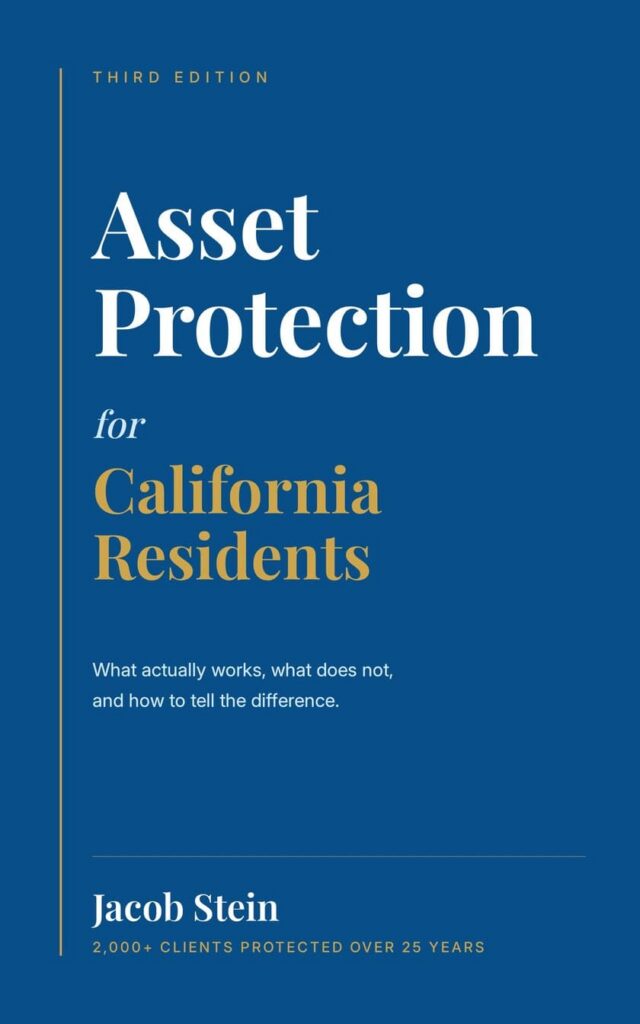
Asset Protection for California Residents
Third Edition
Jacob Stein · Aliant, LLP · Los Angeles
On this page
Get a written proposal for your own assets
Free, specific to your facts, substantive, and yours to keep.
Reserved for the readers of the book.
Answer a set of questions about what you own and how it is titled. You will get back a written proposal built around your actual situation: which structures fit which of your assets, what order I would build them in, and where you are already fine and should not spend money.
About ten minutes
What you own, how it is held, and what you are worried about.
A real proposal
Built around your assets, not a template with your name on it.
Then twenty minutes
Talk it through with me afterward if you want to. No charge.
Free. No payment details, ever. How it works
Everything else on this page is free too. The planning checklist in a form you can work through, the questions readers ask most, and the current California exemption amounts.
Thanks for reading. This page exists because parts of the book go stale faster than the rest of it. Exemption amounts adjust on a schedule. Courts keep deciding things. So rather than ask you to trust a figure that was printed months ago, I keep the moving parts here and update them as they move.
From Asset Protection for California Residents, Third Edition, by Jacob Stein · maximumassetprotection.com/book
The checklist
If you do nothing else, work through these in order.
This is the checklist from the back of the book. Tick items off as you go. Nothing is stored anywhere, so if you want to keep it, print it.
- Insure first.Make sure your liability, umbrella, and professional coverage are adequate before anything else.
- Take inventory.List what you own, how it is titled, and what it is worth.
- Map your exposure.For each asset, ask how easily a creditor could reach it today.
- Name your threats.Separate claims that already exist from those that might arise later. The difference decides what you can safely do.
- Deal with any current claim first.Resolve or contain it before building structures aimed at future creditors.
- Start with the hardest assets.Protect real estate early, because it cannot move and its ownership is public.
- Match the structure to the asset.A trust for the home, an LLC for each rental, an ERISA plan for retirement money, and so on.
- Respect the structure.Keep separate accounts, sign the paperwork, and treat each entity as real.
- Plan early.The best protection is put in place long before a claim.
- Get help when it counts.For anything beyond the basics, work with an experienced asset protection attorney.
Questions readers actually ask
The ten that come up in almost every first conversation.
Yes. It uses ownership tools the law already provides. The United States has a long line of case law protecting private property rights.
The moment a claim exists your options narrow, because a transfer made then can be undone as a voidable transfer. It is rarely too late to do anything, but it is often too late to do the best thing. Plan early. Chapter 3 covers this in detail.
It can help, through a transmutation, but only if your spouse is not exposed to the same creditor and the transfer is made for value and early enough. In California, community property answers for either spouse’s debts. See Chapter 4.
An ERISA plan is very well protected. A California IRA usually is not, because a judge decides how much you need. Rolling an IRA into an ERISA plan is often the best fix. See Chapter 10.
No. Use a trust for a residence, and reserve LLCs for rental property and business assets. See Chapters 5 and 10.
It is the only remedy a creditor has against your LLC or partnership interest: a lien on distributions that the creditor cannot force. It turns your business interest into a poor target. See Chapter 9.
No. Most people are well protected with domestic structures. Offshore planning is for larger estates, liquid assets, and serious threats. See Chapters 6 and 8.
Usually, yes. A creditor can question you under oath. Protection comes from where your assets sit and how they are titled, not from hoping no one looks. See Chapter 2.
Two things: carry enough insurance, and plan before there is a claim. See Chapter 1.
You can do some of it, but forms are not enough. Knowing which tool fits which asset, and respecting the structure afterward, is where plans succeed or fail. See Chapter 1.
California exemptions, current amounts
What a creditor cannot take from you, and whether you have to ask for it.
These are the figures behind Figure 2 in the book. Most of them are set by the Judicial Council and reset every three years. The homestead and the bank deposit account adjust every January, so those two move faster than the rest.
Amounts effective April 1, 2025 unless noted. Page last reviewed August 2026.
| Asset | What is protected | Claim required? |
|---|---|---|
| Homestead (principal residence) | The greater of $300,000 or your county’s prior-year median home price, capped at $600,000. Both figures adjust for inflation every January 1, so the working numbers are higher than the statute reads. The cap currently runs to approximately $750,000. | Automatic* |
| Motor vehicle | $8,625 of equity, or the sale or insurance proceeds | Must claim |
| Household goods, clothing, personal effects | No dollar cap. Whatever is ordinarily and reasonably necessary | Automatic |
| Jewelry, heirlooms, art | $10,950 | Must claim |
| Tools of the trade | $10,950, or $21,900 if both spouses share the trade | Must claim |
| Life insurance, unmatured policy loan value | $17,525 in the aggregate | Must claim |
| Life insurance, matured policy benefits | The amount reasonably necessary for support | Must claim |
| Bank deposit account | About $2,200, adjusted annually. Higher amounts apply where the account receives direct deposits of Social Security or public benefits. | Automatic |
| Retirement plans | Company plans such as 401(k)s and defined-benefit pensions are fully protected. IRAs and self-employed plans are protected only to the amount needed for support, which is a judge’s call | Varies |
| Unemployment, workers’ comp, bodily-injury claims | Exempt | Automatic |
The two that move every year. The homestead and the bank deposit account adjust each January, while everything else on this list is reset by the Judicial Council every three years. If you need the exact figure for the current year, the controlling amounts are published by the Judicial Council on form EJ-156.
* The homestead is automatic in the sense that a creditor needs a court order before it can force a sale, and a recorded homestead declaration is optional. Every other exemption on this list has to be claimed by filing with the levying officer, and people lose exemptions by missing that deadline. That is the single most common own-goal in this area.
How the proposal works
A written plan for your own assets, before you ever speak to me.
Most firms in this field offer you a free consultation, which usually means half an hour of being sold to. I would rather hand you something you can read on your own time and judge on its merits.
Answer a set of questions about what you own and how it is titled, and you will get back a written proposal built around your actual facts. Which structures fit which of your assets. What order I would build them in, because sequence matters more than people expect. Where your real exposure sits, and where you are already fine and should not spend money.
1
Answer the questions
What you own, how it is held, and what you are worried about. It takes about ten minutes and there are no trick questions.
2
Get the proposal
A written plan specific to your assets, not a template with your name on it. We strive to turn it around within 24 hours.
3
Twenty minutes with me, if you want it
Once you have read it, we can talk it through. No charge for that either, and no obligation at the end of it.
Free. No payment details, ever.
One thing you should know.
A proposal is a starting point for a conversation, not legal advice, and requesting one does not make me your lawyer. Nothing becomes advice you can rely on until we have actually spoken and I understand your facts.
Who is writing this
I am a practicing attorney and I have spent more than 25 years protecting the wealth of over two thousand clients from plaintiffs, creditors, and government agencies. They come to me facing business lawsuits, auto accidents, loan and personal guarantee defaults, and government investigations. Some simply own too much to leave unprotected.
I have taught more than 1,000 continuing education seminars on asset protection, trust law, and tax law to attorneys, CPAs, and financial professionals, spent ten years as an adjunct professor of taxation in the graduate tax program at Cal State Northridge, and wrote A Lawyer’s Guide to Asset Protection Planning in California, the manual practitioners use. I am the managing partner of Aliant, LLP in Los Angeles, a California Certified Tax Law Specialist certified by the State Bar of California’s Board of Legal Specialization, and ranked in the Chambers and Partners High Net Worth Guide.
I do not sell prepackaged products, and I have no patience for planning that only looks like protection.
This page is educational. It is not legal advice, and reading it does not create an attorney-client relationship. Every situation turns on its own facts. Before you act on anything here, talk to a lawyer licensed in your state about your own circumstances. The law changes and the dollar figures adjust on a schedule, so verify any figure before you rely on it. Nothing here is intended to help anyone hinder a creditor who already has a claim, defraud a creditor, conceal assets from a court, or avoid a tax that is lawfully owed.
Jacob Stein, Aliant, LLP, is responsible for the content of this page. Law stated as of July 1, 2026. Page last reviewed August 2026.